In a context of increasing water scarcity, good intentions are no longer enough. Digital transformation is profoundly changing the way we manage this resource: every cubic meter is beginning to become a measurable, traceable, and verifiable asset.
For years, many organizations expressed their commitments around water from the realm of intentions. However, the new landscape demands more than words: it demands measurement, evidence, and traceability.
From Intention to Metrics: The Imperative of Quantification
In 2026, speaking about water management without quantification is becoming increasingly unsustainable. Many organizations claim: “We are committed to becoming water positive.” But today, those statements are increasingly confronted with a direct and concrete question:
How many cubic meters?
In this context, Volumetric Water Benefits (VWBs) have become a fundamental metric. It is no longer about abstract declarations, but about real and measurable impact: cubic meters saved, reused, and replenished.
Measuring accurately, however, is not trivial. It requires robust baselines, understanding of the local hydrological context, consistent methodologies, and traceable data flows. For a long time, the absence of these elements forced many companies to choose between rough estimates or complex and costly studies.
In water-stressed regions, from the Atacama Desert to Brazil’s semi-arid sertão, the margin for error is even smaller.
Until artificial intelligence began to change the rules.
Today, IoT sensors provide real-time telemetry on flow, pressure, and water quality. Machine learning algorithms analyze historical records to anticipate drought probabilities and periods of water stress. And cloud intelligence transforms fragmented data into operational insight.
The result is clear: scalable, automated, and auditable volumetric benefit calculations. Companies can forecast water savings months in advance and prioritize interventions according to expected water return.
From Data to Decisions: The BOWNT Approach
At BOWNT, we started with a seemingly simple question:
What would happen if water management data could be naturally integrated into operations, instead of being extracted, exported, and analyzed in silos?
From this reflection, our mission was born: transforming fragmented operational data into measurable decisions and outcomes — not as a parallel project, but as a layer embedded into daily operations.
Capturing the Signal
Everything starts at the source.
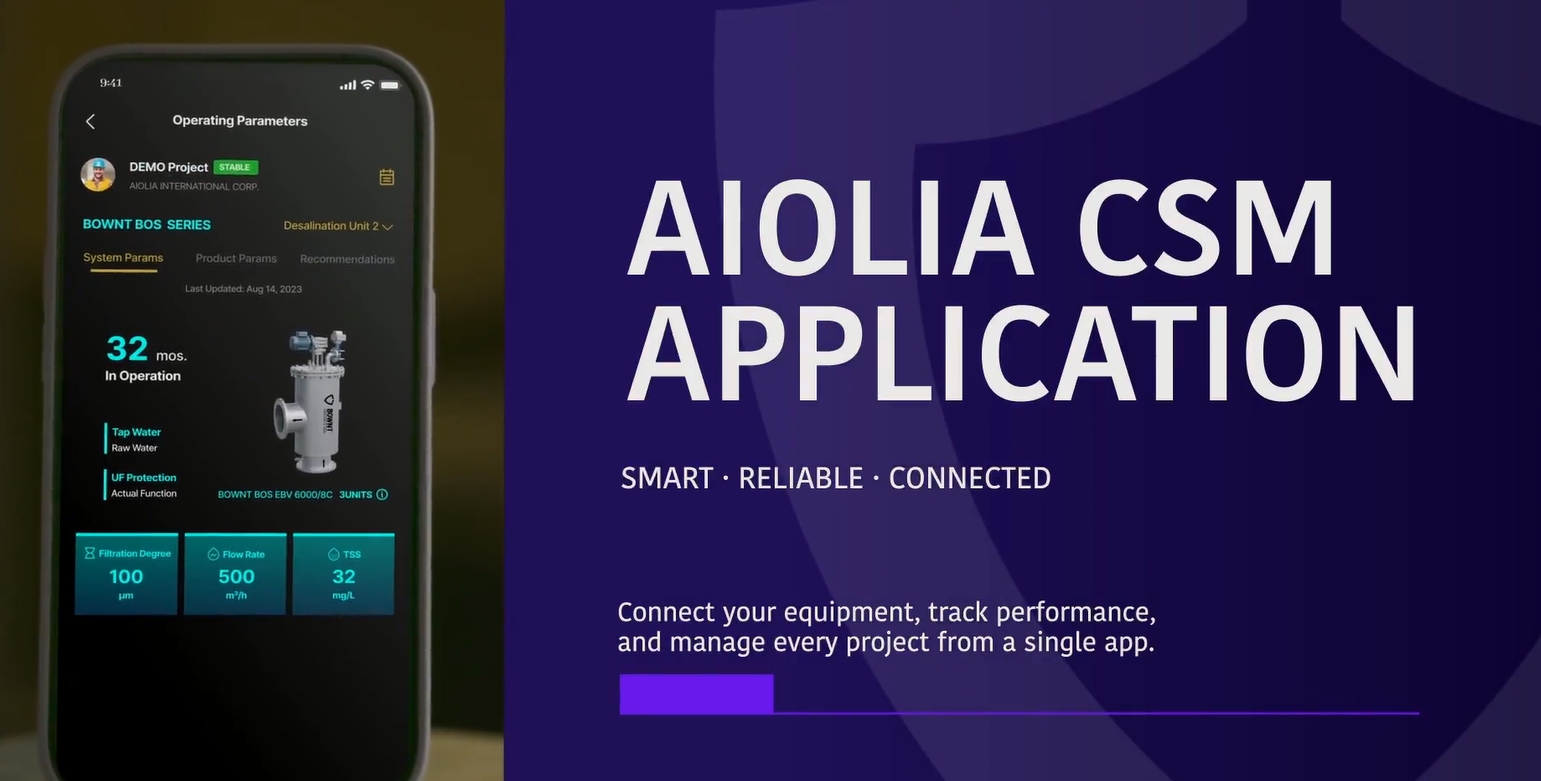
Our filtration systems — BOS/BOD self-cleaning filters, BOC cartridge filters, and BOM multimedia filters — are not merely passive equipment. They operate as intelligent data nodes capable of continuously transmitting operational parameters such as:
Flow rate
Differential pressure
Cleaning cycles
Temperature
Each of these parameters provides information. Every data point tells a story.
When Data Begins to Speak
Raw telemetry flows into the cloud, where BOWNT’s artificial intelligence layer transforms that stream of information into operational knowledge.
Visualized trends allow performance degradation to be detected before failure occurs. A gradual pressure increase stops being just a number and becomes an early warning — an opportunity to intervene while intervention is still efficient and economical.
Intelligent alerts are not triggered solely when thresholds are exceeded: they learn. The system identifies what “normal” means for each operation, distinguishes routine fluctuations from real risks, and generates alerts accordingly.
Meanwhile, predictive diagnostics anticipate what will happen next: when a membrane will need cleaning, how much water that process may consume, or how maintenance schedules can be optimized by balancing equipment lifespan with water savings.
When Operations Become Impact
When data flows from equipment to the cloud and from there into operational knowledge, something remarkable happens: operational metrics become sustainability metrics.
Industrial Water Reuse
Treatment optimization and filtration efficiency make it possible to return more water to industrial processes. Every cubic meter reused equals one cubic meter not extracted — a crucial metric for water-intensive industries operating in water-stressed regions.
Efficient Membrane Protection
Optimized cleaning cycles and predictive maintenance reduce downtime, chemical consumption, and membrane wear. The water saved translates directly into quantifiable volumetric benefits.
Traceable Treatment
Water treated for reuse or desalination is supported by a continuous data thread: consistent quality, verifiable volumes, and auditable records.
When claims require proof, the proof exists.
This is the transition from narrative to numbers. From saying “we care about water” to being able to state “we have saved millions of cubic meters through operational optimization.”
The Question That Truly Matters
Across industries and geographies, one recurring question emerges:
What stands between your organization and measurable water positive targets: the data, the methodology, or a platform capable of connecting both?
What is missing is the decision to move from intention to integration: to stop treating water measurement as a reporting exercise and start integrating it into operations, demanding that every cubic meter tells its story.
The water-positive future will not be built through press releases.
It will be built through pressure sensors, flow meters, and algorithms capable of transforming data into liters — and liters into real impact.
BOWNT builds that connective tissue between aspiration and evidence, between equipment and knowledge, between today’s operations and tomorrow’s water security.
The question is not whether you can measure your water impact.
The real question is: Can you afford not to?